
Byzantine Empire: Every Emperor From Arcadius to Constantine XI
The Byzantine Empire, the Eastern Roman Empire ruled from Constantinople: the complete list of emperors by dynasty from 395 to 1453, the key events, its religion and culture, and why 'Byzantine' is a later name.
Last updated September 2026
Contents16
- The Byzantine Empire at a glance
- Byzantine emperors, 395-610
- Byzantine emperors, 610-867
- Byzantine emperors, 867-1204
- Byzantine emperors, 1204-1453
- Key events in Byzantine history
- How the Byzantine Empire was governed
- Byzantium and its neighbours
- Greek fire
- Women in Byzantine power
- Religion, art and learning
- Everyday life in Constantinople
- Money and trade
- The fall of Constantinople
- Legacy
- Verdict: the Byzantine Empire in brief
The Byzantine Empire is the name historians give to the Roman Empire in the east. It was ruled from Constantinople for more than a thousand years. It began as the eastern half of the Roman state.
It outlived the western half by nearly a thousand years. This page lists every Byzantine emperor by dynasty and sets out the key events. It also explains why the empire's own people would not have known the name "Byzantine".
TL;DR: The Byzantine Empire was the Eastern Roman Empire, centred on Constantinople. After the split of 395, about 90 emperors reigned, from Arcadius to Constantine XI. Its high points came under Justinian I in the 500s and Basil II around 1000. It lost Constantinople to the Fourth Crusade in 1204. It won the city back in 1261. It fell to the Ottomans on 29 May 1453.
The Byzantine Empire at a glance
| Field | Record | Status |
|---|---|---|
| Capital | Constantinople (Istanbul), dedicated in 330 | Reviewed |
| Separate eastern court | From the division of 395 | Reviewed |
| Languages | Latin for government at first; Greek from the 7th century | Reviewed |
| Religion | Christianity; Eastern Orthodox after the schism with Rome | Reviewed |
| Name used by its people | Basileia ton Rhomaion, "Empire of the Romans" | Reviewed |
| End | 29 May 1453, Ottoman conquest of Constantinople | Reviewed |
Scroll for more →
The name "Byzantine"
"Byzantine Empire" as a name.
Status: Disputed A modern label, not the empire's own name.
Note: The empire's people called themselves Rhomaioi, Romans. They called their state the Empire of the Romans. "Byzantine" comes from Byzantium, the old Greek name of Constantinople.
The German scholar Hieronymus Wolf made it popular in 1557, and it spread in the centuries after. A study in the Cambridge journal Byzantine and Modern Greek Studies looks at how imperial writing in the 600s still showed a Roman identity. Many historians now use "Eastern Roman Empire", or both names together, as this page does.
Sources: Cambridge University Press, "Did the Byzantines call themselves Byzantines", Byzantine and Modern Greek Studies; Lumen Learning, "Naming of the Byzantine Empire".
Byzantine emperors, 395-610
Reign dates show senior emperors. Many emperors also crowned sons or colleagues as co-emperors. They are left out unless they ruled in their own right.
| Emperor | Reign | Dynasty |
|---|---|---|
| Arcadius | 395-408 | Theodosian |
| Theodosius II | 408-450 | Theodosian |
| Marcian | 450-457 | Theodosian, by marriage |
| Leo I | 457-474 | Leonid |
| Leo II | 474 | Leonid |
| Zeno | 474-475, 476-491 | Leonid |
| Basiliscus | 475-476 | Usurper |
| Anastasius I | 491-518 | Leonid, by marriage |
| Justin I | 518-527 | Justinian |
| Justinian I | 527-565 | Justinian |
| Justin II | 565-578 | Justinian |
| Tiberius II Constantine | 578-582 | Justinian |
| Maurice | 582-602 | Justinian |
| Phocas | 602-610 | None |
Scroll for more →
Byzantine emperors, 610-867
| Emperor | Reign | Dynasty |
|---|---|---|
| Heraclius | 610-641 | Heraclian |
| Constantine III and Heraklonas | 641 | Heraclian |
| Constans II | 641-668 | Heraclian |
| Constantine IV | 668-685 | Heraclian |
| Justinian II | 685-695, 705-711 | Heraclian |
| Leontios | 695-698 | None |
| Tiberios III | 698-705 | None |
| Philippikos | 711-713 | None |
| Anastasios II | 713-715 | None |
| Theodosios III | 715-717 | None |
| Leo III | 717-741 | Isaurian (Syrian) |
| Constantine V | 741-775 | Isaurian |
| Leo IV | 775-780 | Isaurian |
| Constantine VI | 780-797 | Isaurian |
| Irene | 797-802 | Isaurian, by marriage |
| Nikephoros I | 802-811 | Nikephorian |
| Staurakios | 811 | Nikephorian |
| Michael I Rangabe | 811-813 | Nikephorian, by marriage |
| Leo V | 813-820 | None |
| Michael II | 820-829 | Amorian |
| Theophilos | 829-842 | Amorian |
| Michael III | 842-867 | Amorian |
Scroll for more →
Byzantine emperors, 867-1204
| Emperor | Reign | Dynasty |
|---|---|---|
| Basil I | 867-886 | Macedonian |
| Leo VI | 886-912 | Macedonian |
| Alexander | 912-913 | Macedonian |
| Constantine VII | 913-959 | Macedonian |
| Romanos I Lekapenos | 920-944 (senior co-emperor) | Lekapenos |
| Romanos II | 959-963 | Macedonian |
| Nikephoros II Phokas | 963-969 | Soldier-emperor |
| John I Tzimiskes | 969-976 | Soldier-emperor |
| Basil II | 976-1025 | Macedonian |
| Constantine VIII | 1025-1028 | Macedonian |
| Romanos III Argyros | 1028-1034 | Macedonian, by marriage to Zoe |
| Michael IV | 1034-1041 | Macedonian, by marriage to Zoe |
| Michael V | 1041-1042 | Adopted by Zoe |
| Zoe and Theodora | 1042 | Macedonian |
| Constantine IX Monomachos | 1042-1055 | Macedonian, by marriage to Zoe |
| Theodora | 1055-1056 | Macedonian |
| Michael VI | 1056-1057 | None |
| Isaac I Komnenos | 1057-1059 | Komnenos |
| Constantine X Doukas | 1059-1067 | Doukas |
| Romanos IV Diogenes | 1068-1071 | Doukas, by marriage |
| Michael VII Doukas | 1071-1078 | Doukas |
| Nikephoros III | 1078-1081 | None |
| Alexios I Komnenos | 1081-1118 | Komnenos |
| John II Komnenos | 1118-1143 | Komnenos |
| Manuel I Komnenos | 1143-1180 | Komnenos |
| Alexios II Komnenos | 1180-1183 | Komnenos |
| Andronikos I Komnenos | 1183-1185 | Komnenos |
| Isaac II Angelos | 1185-1195, 1203-1204 | Angelos |
| Alexios III Angelos | 1195-1203 | Angelos |
| Alexios IV Angelos | 1203-1204 | Angelos |
| Alexios V Doukas | 1204 | None |
Scroll for more →
Byzantine emperors, 1204-1453
The Fourth Crusade took Constantinople in 1204. Byzantine rulers carried on in exile at Nicaea, in Asia Minor. They took the city back in 1261.
| Emperor | Reign | Dynasty |
|---|---|---|
| Theodore I Laskaris | 1205-1221 (at Nicaea) | Laskaris |
| John III Vatatzes | 1221-1254 (at Nicaea) | Laskaris, by marriage |
| Theodore II Laskaris | 1254-1258 (at Nicaea) | Laskaris |
| John IV Laskaris | 1258-1261 | Laskaris |
| Michael VIII Palaiologos | 1259-1282 | Palaiologos |
| Andronikos II | 1282-1328 | Palaiologos |
| Andronikos III | 1328-1341 | Palaiologos |
| John V | 1341-1391, with interruptions | Palaiologos |
| John VI Kantakouzenos | 1347-1354 | Kantakouzenos |
| Andronikos IV | 1376-1379 | Palaiologos |
| John VII | 1390 | Palaiologos |
| Manuel II | 1391-1425 | Palaiologos |
| John VIII | 1425-1448 | Palaiologos |
| Constantine XI | 1449-1453 | Palaiologos |
Scroll for more →
Key events in Byzantine history
| Year | Event |
|---|---|
| 330 | Constantine dedicates Constantinople |
| 395 | The empire is divided between Theodosius I's sons |
| 529-534 | Justinian's code of Roman law |
| 537 | Hagia Sophia completed |
| 636 | Defeat at the Yarmuk; Syria and Palestine lost to the Arab conquests |
| 717-718 | Arab siege of Constantinople fails |
| 726-843 | Iconoclasm, with a break from 787 to 815 |
| 1054 | Formal break between the churches of Rome and Constantinople |
| 1071 | Defeat by the Seljuk Turks at Manzikert |
| 1204 | Fourth Crusade sacks Constantinople |
| 1261 | Michael VIII retakes the city |
| 1453 | Ottoman conquest; Constantine XI killed |
Scroll for more →
How the Byzantine Empire was governed
The emperor stood at the head of the state and the army. In practice he also led much of the church. There was no fixed law of succession.
An emperor could crown a son or a chosen colleague as co-emperor. But a usurper could also take the throne. All he needed was to win over the army, the palace or the people of Constantinople.
From the 600s the empire's provinces were reorganised into military districts called themes. A general ran each theme. He controlled both the army and the civil government in his area. Soldiers were often given land in return for service.
A large civil service in Constantinople managed taxes, law and diplomacy. From the late 900s, a unit of Scandinavian soldiers guarded the emperor. English soldiers joined it later. It was called the Varangian Guard.
Byzantium and its neighbours
| Neighbour | Main period of contact | Outcome |
|---|---|---|
| Sasanian Persia | 4th-7th centuries | Long wars ending in Heraclius's victory in 628 |
| Arab caliphates | From the 630s | Loss of Syria, Egypt and North Africa; sieges of Constantinople beaten off |
| Bulgarians | 7th-11th centuries | Repeated wars; Basil II annexed Bulgaria in 1018 |
| Rus | 9th-11th centuries | Raids, then trade; Vladimir of Kiev accepted Christianity around 988 |
| Normans | 11th-12th centuries | Loss of southern Italy; invasions of the Balkans |
| Venice | 10th-15th centuries | Trading privileges; Venetian role in the Fourth Crusade |
| Seljuk Turks | 11th-13th centuries | Loss of much of Anatolia after Manzikert |
| Ottoman Turks | 14th-15th centuries | Steady loss of territory; conquest of Constantinople in 1453 |
Scroll for more →
Greek fire
The Byzantine navy used a fire weapon known to history as Greek fire. It was sprayed from ships through tubes, and it burned even on water. Byzantine writers say an engineer named Kallinikos brought it in during the 670s, when Arabs attacked Constantinople. Its exact recipe was a state secret. It is still not known.
Women in Byzantine power
Several women shaped Byzantine history. The empress Theodora, wife of Justinian I, is said to have talked him out of fleeing during the Nika riots of 532. Irene ruled alone from 797 to 802.
The sisters Zoe and Theodora reigned jointly in 1042. Anna Komnene, daughter of Alexios I, wrote the Alexiad. It is a history of her father's reign, and one of the first major histories written by a woman.
Religion, art and learning
The Byzantine Empire was a Christian state. The emperor was seen as God's chosen ruler on earth. Church and state were closely linked. Religious disputes were matters of imperial policy. One example was iconoclasm, the long conflict over religious images.
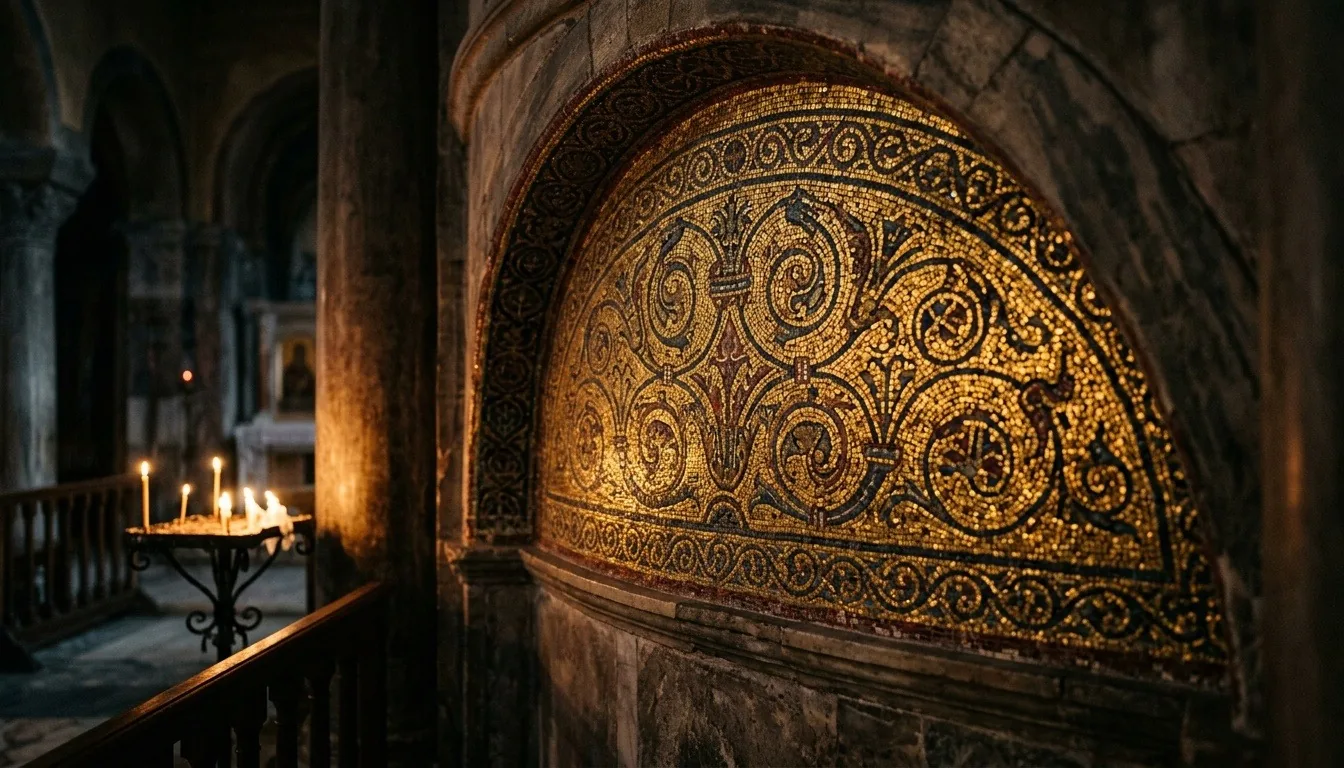
Byzantine art is known for its mosaics and icons. Its buildings are known for domed churches such as Hagia Sophia. Justinian built it, and it was finished in 537. Byzantine scholars copied and kept much of ancient Greek writing. Many classical texts survive today only because Byzantine scribes copied them.
Everyday life in Constantinople
At its height Constantinople was the largest city in Christian Europe. Its people depended on grain shipped from Egypt until the 600s. Later it came from Thrace and the Black Sea.
Chariot racing in the Hippodrome split the city into rival fan groups, the Blues and the Greens. Their riots could shake the government, as in the Nika riots of 532. Great churches, markets and the imperial palace filled the city centre.
Money and trade
The Byzantine gold coin was the solidus, called the nomisma in Greek. It kept a stable weight and purity for about seven centuries. That lasted from Constantine until it was debased in the 1000s.
It was trusted across the Mediterranean and beyond. Constantinople sat on the trade routes between Europe and Asia, and between the Black Sea and the Mediterranean. That made the empire rich.
The fall of Constantinople
By the 1400s, the empire held little more than Constantinople and a few lands in Greece. The Ottoman sultan Mehmed II laid siege to the city from April 1453. He had a large army and heavy cannon.
On 29 May 1453 his troops broke through the land walls. Constantine XI died in the fighting. The last Byzantine outposts, Mistra and Trebizond, fell in 1460 and 1461.
Legacy
The Byzantine Empire kept Roman law alive through Justinian's code. It kept Greek learning alive too, and Byzantine scholars carried it to Italy before and after 1453. It spread Orthodox Christianity to the Balkans and Russia.
After 1453, Russian writers began to describe Moscow as the heir of Constantinople. Russian rulers later took the title tsar, from the Latin Caesar. That story goes on in the Romanov dynasty pages.
To read more, try our guide to the best Roman history books. It picks seven. Together they cover Rome from the Republic to 1453.
Verdict: the Byzantine Empire in brief
The Byzantine Empire was the eastern heir of the Roman Empire. It was ruled from Constantinople from 395, or from 330, until 29 May 1453. About 90 emperors reigned in that time.
The last dynasty was the Palaiologoi. Its people called themselves Romans, so this site marks the name "Byzantine" as a later label. For the early centuries, see the Roman Empire of the East page. For the dynasties, see the Roman dynasty page.
The wider story, from Augustus to 1453, is on the Eastern Roman Empire page.
Sources checked for this page
- Britannica, "Byzantine Empire: The 6th century, from East Rome to Byzantium"
- Britannica, "List of emperors"
- World History Encyclopedia, "Byzantine Empire"
- History.com, "Byzantine Empire"
- De Imperatoribus Romanis
- Britannica, "Constantine XI Palaeologus"
- Britannica, "Fourth Crusade"
Questions people also ask
What was the Byzantine Empire?
The continuation of the Roman Empire in the east, ruled from Constantinople (modern Istanbul) until 1453. Historians call it Byzantine after Byzantium, the old name of its capital, but it called itself the Roman Empire.
When did the Byzantine Empire begin?
There is no single date. Historians use 330, when Constantine dedicated Constantinople, 395, when the empire was divided, or the 7th century, when it became mainly Greek-speaking.
When did the Byzantine Empire end?
On 29 May 1453, when the Ottoman sultan Mehmed II captured Constantinople and the last emperor, Constantine XI, died in the fighting.
Who was the greatest Byzantine emperor?
Justinian I (527-565) and Basil II (976-1025) are most often named. Justinian reconquered much of the West and codified Roman law; Basil II brought the medieval empire to its greatest extent.
What language did the Byzantines speak?
Greek was the main language of the people and, from the 7th century, of government. Latin was the language of law and administration in the early centuries, and many other languages were spoken across the empire.
How many Byzantine emperors were there?
About 90 from the division of 395 to 1453, depending on whether co-emperors, joint rulers and short-lived usurpers are counted separately.